For help fixing relationship mistakes in trees, see Fixing Relationships in Trees. For help adding an adopted family to your tree, see Listing Adopted Family in a Tree. For help with duplicate people appearing in your tree, see Merging Duplicate People.
Being related means that people are connected in some way—usually by birth, adoption, or affinity (marriage or partnership). In genealogy and family history, kinship terms (like siblings, parents, grandparents, first cousins, and once removed) describe how two people are connected or related, usually through common ancestors.
Common ancestors
An ancestor is anyone you descend from. In families, to descend means to "come from." You descend from your parents, who descend from their parents, who descend from their parents, and so on. That chain of parents and children are your ancestors.
This means that not every older relative is your ancestor. For example, your aunts and uncles are your relatives but not your ancestors, because you don’t descend from them.
A common ancestor is someone you and a relative both descend from. For example, your parents, grandparents, and great-grandparents are all common ancestors to you and your siblings.
The most recent common ancestor is the nearest-to-you shared ancestor. For example, you and your 1st cousin may both descend from your great-great-grandmother, but she wouldn't be your most recent common ancestor. Since 1st cousins share grandparents (and a grandparent relationship is closer to you than a great-great-grandparent), your grandparent would be your most recent common ancestor.
Generations
In family trees, people in the same generation are the same number of degrees (people) away from a common ancestor. You and a sibling would be in the same generation because it takes each of you one step to get to your common ancestor—your parents.
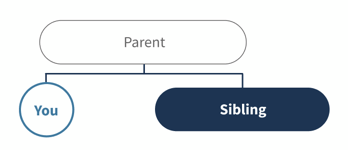
You and your niece are in different generations because it takes you a different number of steps to get to a common ancestor—your parents (one step), her grandparents (two steps).
If you’re calculating the number of generations between you and your descendants, the shared ancestor is you. Your children are one generation from you, their children are two generations away, and so on.
Aunts, uncles, nieces, and nephews
An aunt or uncle is a sibling of your parent or a person married to your parent’s sibling. For example, if your aunt marries a man, he becomes your uncle. If she marries a woman, your aunt’s wife also becomes your aunt.
Sticking strictly to biological relationships, an aunt is your mom or dad’s sister, and an uncle is your mom or dad’s brother.
Your nephew is the son of your brother or sister, and your niece is your brother or sister’s daughter.
“Grand” relationships
Grand means two generations apart. For example, a grandparent and grandchild are two generations away: child > parent (1 generation) > grandparent (2 generations).
Like with grandparents, “grand” with aunts, uncles, nieces, and nephews also means two generations away. Your grandaunt is your grandparent’s sister, and you are her grandniece or grandnephew.
Many call their grandaunt or granduncle their “great” aunt or “great” uncle. The word varies by family and region. At Ancestry, we use “grand” instead of “great” for this relationship.
“Great” relationships
Great means three or more generations apart.
Each “great” adds one more generation. A great-grandparent is three generations away because "great" adds one generation, and “grand” adds two generations.
"Great" and "grand" work the same way with aunts, uncles, nieces, and nephews. Your granduncle is two generations away, and your great-granduncle is three generations away. Your great-grandniece is your sibling's great-granddaughter. You are your great-grandniece's great-grandaunt.
Cousins
First cousins are the children of (their parent's) siblings. They share a set of grandparents. First cousins are the same generation as each other. They're both two generations away from the grandparents they share.
If first cousins have children, the children are second cousins to each other. They're the same generation because they share a set of great-grandparents.
If second cousins have children, the children are third cousins to each other. They're in the same generation because they share a set of great-great-grandparents.
Removed
Removed means a different generation. When cousins are in different generations than each other, we say they're removed. "Removed" is like “grand” and “great,” but with cousins.
Once removed means a difference of one generation, twice removed means a difference of two generations, and so forth. If your first cousin has a child, this child is your first cousin once removed.
A difference of one generation higher in the tree is still once removed. Your parent's first cousin is your first cousin once removed.
Half relationships
Children who share only one parent are half siblings.
All other half relationships stem from a half sibling relationship. People related to you through your half sibling or the half sibling of one of your ancestors will be "half" relationships to you.
For example:
- your half nephew is your half sibling's son
- your half grand-aunt is your grandparent's half sister
- the children of half siblings are half cousins