Your DNA contains a record of your ancestors, but you aren’t a carbon copy of any one of them.
The mix of DNA you inherit is unique to you. You receive 50% of your DNA from each of your parents, who received 50% of theirs from each of their parents, and so on. In the chart below, you can see how the amount of DNA you receive from a particular ancestor decreases over generations. If you go back far enough, there is a chance that you inherited no DNA from a particular ancestor.
The chart below helps illustrate how different segments of DNA might have been passed down from your grandparents to make your unique DNA. Assume each letter represents a segment of DNA. Take note of these things:
- Which letters get passed down to each generation is random [the fact that the letters spell names in this example is simply to help with the illustration].
- Not every letter gets passed down.
- Just because a child doesn’t have a letter doesn’t mean that an earlier ancestor didn’t have that letter.
- Siblings can have different combinations of letters.
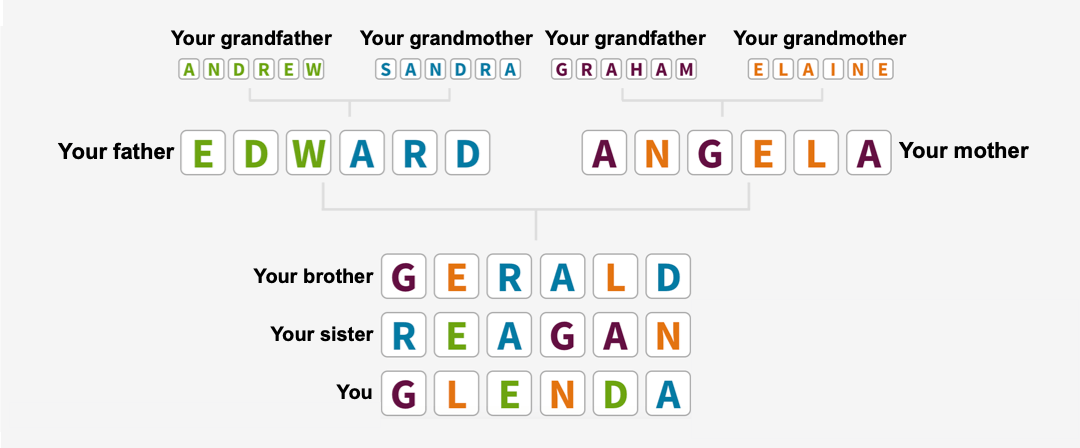
In the example above, your paternal grandfather has the unique DNA of ANDREW. He can pass down only 50% of his DNA to each child. In your father’s case, the “pieces of DNA” randomly selected to be passed on to him are represented by the letters EDW. At the same time, your grandmother SANDRA provides the randomly selected segments ARD, which combine with her husband’s EDW to create your father’s unique genetic signature: EDWARD. Notice that not all of the letters from ANDREW and SANDRA get passed down to EDWARD.
Your father, EDWARD, has three children with your mother, whose genetic signature is ANGELA. EDWARD and ANGELA each pass 50% of their DNA, randomly selected, to each of their children, who end up with the genetic signatures GLENDA, GERALD, and REAGAN.
While having more children increases the chances of passing on more of your DNA, if you look closely, you’ll see that even with three children, not all of EDWARD and ANGELA’s DNA segments made it to the next generation.
This is a simplified example of how genetic inheritance works in all of us. By understanding how DNA is inherited, you can see how and why you have some DNA segments that match your relatives, and others that do not, why you may or may not have inherited DNA segments associated with a certain ancestral region, and why getting multiple people in your family https://internalancestrysupport.zendesk.com/hc/en-us/articles/53933269700243-/hc/en-us/articles/53933269959827-/hc/en-us/articles/53933318476179-/hc/en-us/articles/53933340474387-tested can help you discover more of your family’s genetic tree.
Below are three sets of https://internalancestrysupport.zendesk.com/hc/en-us/articles/53933316730515-/hc/en-au/articles/53933330544787-Update-Q2-2022-218-New-Communities results from three siblings. These results display how genetic inheritance is random, just like the letter block example above explains. Focus on the England & Northwestern Europe region in each https://internalancestrysupport.zendesk.com/hc/en-us/articles/53933269700243-/hc/en-us/articles/53933269959827-/hc/en-us/articles/53933318476179-/hc/en-us/articles/53933340474387-test; percentages range from 33–45%. Looking at the Norway region, two of the siblings have the region in their results, and one does not.
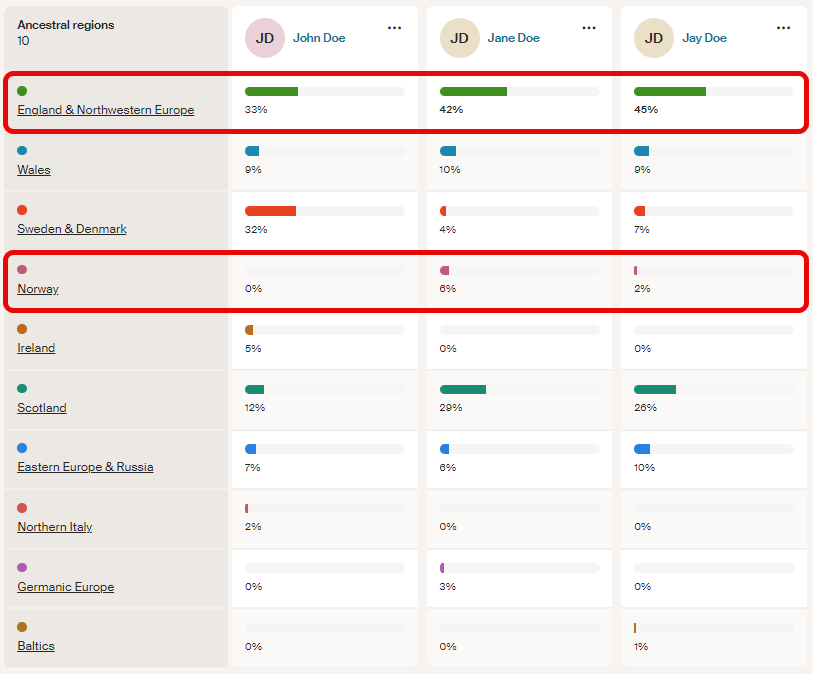
These siblings’ DNA results are all different because none of them are identical twins. This is why it’s fun and important to get others in your family https://internalancestrysupport.zendesk.com/hc/en-us/articles/53933269700243-/hc/en-us/articles/53933269959827-/hc/en-us/articles/53933318476179-/hc/en-us/articles/53933340474387-tested—each of us carries unique pieces of DNA that can unlock our family’s story.
To have other family members https://internalancestrysupport.zendesk.com/hc/en-us/articles/53933269700243-/hc/en-us/articles/53933269959827-/hc/en-us/articles/53933318476179-/hc/en-us/articles/53933340474387-tested, visit our DNA page. To learn more about how https://internalancestrysupport.zendesk.com/hc/en-us/articles/53933316730515-/hc/en-au/articles/53933330544787-Update-Q2-2022-218-New-Communities determines ancestral regions, see our article about ancestral regions.