To help you understand how you might be related to your DNA matches, Ancestry shows you how much identical DNA you share with each match. However, people can share identical DNA for reasons other than a recent common ancestor. That’s why Ancestry performs extra tests to show you the amount of shared DNA that comes from a recent common ancestor. If you want to know all the identical DNA you share with a match, you can look at the amount of unweighted shared DNA.
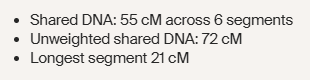
An example of a DNA match where the individuals share 55cM or identical DNA from a recent common ancestor. They also share an additional 17cM of identical DNA not from a common ancestor.
Shared identical DNA doesn’t always mean a recent common ancestor
In most cases, two people will share identical DNA because they have a recent common ancestor. For example, first cousins with a common grandparent share about 1,000 cM of identical DNA. An AncestryDNA test can find you matches up to the level of an eighth cousin, someone who you share a 7x great-grandparent with.
However, two people can share identical DNA for reasons other than a recent common ancestor. The main reason is that the individuals share the same ancestral origins. As part of the genetic processes that occur over time, a population of people can end up sharing a specific segment or segments of identical DNA among all its members. This happens because of endogamy within a population and isolation (genetically) from other populations.
The result is that even two people from the same population can share detectable amounts of identical DNA. This can make it look like you’re more closely related to some of your DNA matches than you really are. Or make you look related even if you aren’t.
Shared DNA versus unweighted shared DNA
Shared DNA is the amount of identical DNA that you and a match inherited from one or more recent common ancestors. Ancestry filters out DNA not connected to a recent common ancestor, giving you a more accurate estimated relationship. Ancestry does this using an algorithm called Timber.
Unweighted shared DNA is the total amount of identical DNA two people share. In most cases, two people will share DNA because they share a recent common ancestor. However, identical DNA may also be shared by people from the same origins. The impact of this is most often seen in distant relationships, where there is a more distant common ancestor or no common ancestor. Unweighted shared DNA will almost always be larger than shared DNA for distant relationships.
Additional helpful terms
cM (centimorgans): A centimorgan (cM) is a unit that measures the amount of DNA between locations on a chromosome. Technically, the number of centimorgans between two genes indicates the likelihood of the genes being inherited together due to their proximity. The total amount of DNA you share with your matches is measured in centimorgans (cMs). In general, the higher the number of centimorgans (cMs), the more closely you’re related. Learn more about genetic inheritance.
Segments: The DNA you share with your matches is distributed across segments of DNA. If you think of your and your match’s DNA as two books, shared DNA segments are identical sentences or paragraphs that appear in both books. The length of the longest segment you and a DNA match have in common can help determine your relationship. Often, sharing fewer, longer segments indicates a closer relationship.